istanbul historical palace etiketine sahip kayıtlar gösteriliyor. Tüm kayıtları göster

6 Ağustos 2018 Pazartesi

Sultana’s Dinner and 1001 Nights Show

Sultana’s: Istanbul’s finest Turkish dinner and show venue


sultana's dinner ile ilgili görsel sonucu
Welcome to the website of Sultana’s Dinner and 1001 Nights Show in Istanbul, Turkey. We’re a well recommended Turkish restaurant with a stage full of Turkish dancing, belly dancing and cultural shows.
If belly dancing in Istanbul is what you’re looking for, then you’re at the right place. Sultana’s present the best belly dance performed by the most talented Istanbul belly dancers. Every night we have three belly dancing performances from three different Turkish belly dancers of Istanbul – with Ottoman-standard hip swinging ability!
Our very own “Harem Show” is a cabaret representation of life in the Ottoman Empire’s Harem, a special room in Topkapı Palace where the only man that could attend was the Sultan. But it was the Sultan’s mother, the Sultana, who had real control over the Harem, and of course, the ladies within it!
The Sultana will be delighted to welcome you at our venue, where you will eat the finest mezes, grilled meats, vegetarian dishes and thrilling Turkish desserts.
Take a look around our website from the menu on the right. Remember, if you book your table online, you get a special meze selection. You also take advantage of discounts. Enjoy!
For Booking ; http://www.sultanas-nights.com/free-table-booking/

Basilica Cistern (Yerebatan Sarayi)

The Basilica Cistern, located in the crowded Eminönü district of Istanbul next to the Hagia Sophia, was built to provide water for the city of Istanbul during the reign of Emperor Justinian I in the 6th century CE. This cistern is an underground chamber of 138 x 64.6 metres. The large space is broken up by a forest of 336 marble columns, which are aesthetically supported by strong  columns and arches. The ceiling vaults, known as Manastır Tonozu (cloister vault), are built without using a mould. The cistern is surrounded by a firebrick wall with a thickness of 3.5 meters and is coated with a special mortar to make it waterproof.
Price
  • Admission TL 30


Originally, there was a stone-paved circle on the cistern. It was later broken by dense housing construction beginning in the Byzantine period continuing into the Ottoman period. The citizens who settled in the vicinity were provided with their daily water requirements from the large round well-like holes opening from the ceiling structure. In 1940, several of the structures built on and around the Basilica Cistern were nationalized and a neat building was constructed at the entrance of the Cistern by the Istanbul Metropolitan Municipality. It was also exposed to a wide range of cleaning process between 1985-1988. Thus dirty water and tons of mud were removed and a promenade platform was built in the cistern. After the cleaning process was completed, the two Medusa heads, masterpieces of the First Age Art of Statuary were used as pedestals at the bottom of the two columns in the northwest corner of the cistern. It is not known exactly when or for what purpose the were antique Medusa and Gorgon heads were brought to the Basilica Cistern.

Unkapanı Atatürk Bridge

hali  ve atat rk k pr s  gece 1964 Unkapanı Atatürk Bridge

Historicly, on the site of the present Unkapanı Ataturk Bridge, there was a bridge called the “Jewish Bridge” (Yahudi Köprüsü) made of wooden planks. The purpose of building a bridge across the Golden Horn was to save citizens from paying a boat fee. For this reason, the bridge was known as the “Pious Deed  Bridge” (Hayrat Köprüsü). The name of the bridge was changed to “Atatürk Bridge” in 1935.

Cağaloğlu Hamam (Bath)

This historical bath located in the Cağaloğlu neighborhood near the Underground Cistern. A plan for the bath was designed by Süleyman Ağa, one of the palace architechs, by order of Sultan Mahmut I in order to provide revenue for both his library and the Ayasofya Mosque (Hagia Sophia). It was then built by Abdullah Ağa in 1741.

Before its construction, the palace built by Nevşehirli Damat İbrahim Paşa stood on its location. The palace was destroyed by a fire in 1740, and the Cağaloğlu Bath was erected on its site. Essentially, the bath consists of two sections, a men’s section and ladies’ section. The entrance door of the ladies’ section is located on a side street called Hamam Street, and the men’s section is found on the main road .
Several architectural innovations are found in the bath’s design which draws the attention of its visitors who have never seen a combination of Baroque and Classical Ottoman style architecture. It is also the last of the great hamams built in the city during the Ottoman era.
The Camekan of Cağaoğlu Hamam, a court surrounded by small individual changing rooms, is covered by a wide dome. There are changing rooms which surround the Camekan which are built on consolidated beams. In the middle of the Hamam, there is a wide pool that is made of a massive marble block, and in the middle of the pool, there is a splendid fountain. The wide dome in the lukewarm section (ılıklık) is raised upon four marble columns and seven cradle-shaped domes that form the roof of the structure which extends from the lukewarm section into the harare (hot section). The hot section, raised upon eight embroidered columns, is covered by a wide dome that dazzles with its grandeur.
The Cağaloğlu Hamam has been in service for two hundred seventy-six years. Today, it is still in operation, and the vast majority of its visitors are foreign tourists.

Suleymaniye Hamam

Suleymaniye Hamam

Suleymaniye Hamam is an historic Turkish bath in İstanbul, Turkey. The building, situated on a hill facing the Golden Horn, was built in 1557 by Turkish architect Mimar Sinan; it was named for Süleyman the Magnificent. It is part of the Suleymaniye mosque complex. The hamam was commissioned by Sultan Süleyman, ruler of the Ottoman Empire between 1520 and 1566. The building is lavishly arched and domed, with elaborate marble inlay work on the walls. Sulemaniye Hamam is a traditional bathhouse consisting of three sections: cold, lukewarm and hot. Temperatures in the hot section can reach 40-60 degrees Celsius (104-140 F). The hamam is still operating today and caters mainly to tourists.  It is the only hamam in Istanbul where men and women bathe togetherMale attendants, called tellak, cater to all the clients.
The haman is suitable for families and couples only. Single males or females will not be admitted
For a quiet time They recommend coming between 10:00 am and 15:00 pm
It is located in a 450 year historical building desinged by the famous arquitect Sinan. You can feel that time is back to the Ottoman period, when you take a bath here.

Church of the Holy Apostles, Constantinople

The Church of the Holy Apostles in Constantinople (modern Istanbul) was one of the most important churches in Christendom. Although it no longer survives, it is worth an entry for its great historical importance.
Originally built by Constantine the Great and rebuilt by Emperor Justinian, the church was was the burial place of the Byzantine Emperors and Patriarchs of Constantinople from the 4th century to the 11th century.
At one time, the Church of the Holy Apostles held the relics of the Christian saints Andrew, Luke, Timothy, John Chrysostom and Gregory the Theologian.
The Church of the Holy Apostles was ruthlessly plundered in the Crusades and later toppled by a severe earthquake. Today, almost nothing of the great church remains, and the Fatih Mosque was built over the site.

History

The Church of the Holy Apostles was originally erected by Emperor Constantine the Great, the first Roman emperor to embrace Christianity, in 330. The church included a large tomb intended for himself as well as 12 empty reliquaries in which he intended to place the relics of the Twelve Apostles.
The mausoleum-church that was the Church of the Holy Apostles broke with imperial tradition in several ways. It broke with funerary custom by establishing a tomb within the city walls and unlike previous imperial mausolea it was not associated with a palace complex. And Constantine’s burial alongside the apostles instead of amongst images of earlier rulers showed his desire to be seen as a saint and a successor to Christ’s own successors.
Constantine died in Nicomedia in 337 and was laid to rest in a sarcophagus in the Church of the Holy Apostles, which was the only church in the city built before his death. Constantius, Constantine’s son and successor, later procured the relics of St. Andrew, Luke, and Timothy to be enshrined in the church.
Two centuries after its completion, the church of the Holy Apostles required total reconstruction. The church was rebuilt by Emperor Justinian and consecrated on June 28, 550. Justinian’s church was designed by the celebrated architects Anthemius of Tralles and Isidorus of Miletus. (See below for description.) Emperor Basil I “the Macedonian” (867-886) later renovated the building.
Second only in importance to the Hagia Sophia among the great churches of the Eastern Empire, the Church of the Holy Apostles was at the center of many great events. Some of its prelates, like Nicetas I (765 780), acceded to the patriarchal throne, and many councils and secret meetings were held under its domes. On certain feast-days, such as the Sunday of St. Thomas and the 21st May, the Emperor and his court attended the liturgy in the church of the Holy Apostles. Until the 11th century, most emperors and many patriarchs and bishops were buried in this church and the relics of many of them were venerated by the faithful.
The true riches and glory of the Church of the Holy Apostles were the impressive collection of relics it possessed. In addition to the skulls of St. Andrew the Apostle, St. Luke the Evangelist and St. Timothy, it had the relics of St. John Chrysostom and St. Gregory the Theologian, placed in reliquaries on either side of the main altar. There were also rows of reliquaries containing the relics of a great number of other saints and martyrs.
During the sack of Constantinople of 1204 in the Fourth Crusade, the church and the imperial sarcophagi were devastated and plundered by the Crusaders: most of the reliquaries, the gold and silver vessels decorated with precious stones, the icons, the imperial crowns, the somptuous vestments and other important objects were carried off to Western Europe. The Crusaders plundered the imperial tombs and robbed them of gold and gems. Not even Justinian’s tomb was spared. Today, many of these relics and treasures remain in the collections of European museums, especially in Rome andSt. Mark’s Basilica in Venice.
When Michael VIII Palaeologus (1261-1282) recaptured the city from the Crusaders, he erected a statue of the Archangel Michael atop a pillar at the church to commemorate the event. In 1328 a severe earthquake toppled the statue. The church, once again restored to a large extent by Andonicus II Palaeologus (1282-1328), was thenceforth abandoned to the ravages of time and neglect as the Byzantine Empire declined and Constantinople’s population fell. The Florentine Cristoforo Buondelmonti saw the dilapidated church in 1420.
In 1454, shortly after the Fall of Constantinople, Mehmet the Conqueror allowed Patriarch Gennadios to install the See of the Orthodox Patriachate at the Church of the Holy Apostles. But because the church was in a dilapidated state and stood in a district where few Christians lived, the Patriarcate was soon transferred to the Theotokos Pammacaristos Church where it remained until 1586 before moving to St George Church. In 1461 Mehmet II demolished the church and built the Fatih Mosque over its foundations.

What to See

There is very little to see today at the site where the Church of the Holy Apostles once stood. Some reused building materials of the church, such as column pieces and stone blocks of the foundations, have been identified in the courtyard of the Fatih Mosque. One important relic of the church, part of the “Column of Flagellation” to which Christ had been bound and flogged is today preserved in the Patriarchal Church of St. George in Istanbul. Outside of Istanbul, the best place to see the remains of the Church of the Holy Apostles is the Treasury of St. Mark’s Basilica in Venice, which displays many reliquaries and glittering treasures plundered during the Crusades.
Thanks to contemporary descriptions, we have a general idea of what the church looked like. The historian Eusebius of Caesarea described Constantine’s construction of it as follows:
He had the church built to a great height, and he decorated it splendidly with slabs of various colors which covered it from the foundation to the roof. And over the roof he put finely fretted work and overlaid it everywhere with gold. The outside portion, which protected the edifice from rainfall, was of bronze rather than tiles, and this too gleamed with the abundance of gold. It brilliantly reflected the rays of the sun and dazzled the distant onlooker. A well-carved tracery of bronze and gold encircled the entire dome.
Other manuscripts have preserved the text of an epigram that was placed over the main gate to the church, recording the deaths of the Twelve Apostles:
Mark is put to death by the people of Alexandria.
The great sleep of life Matthew sleeps.
Rome sees Paul die by the sword.
Philip is given what was given Peter.
Bartholomew suffers death on the cross.
Simon too on the cross ends his life.
In Rome vain Nero crucifies Peter.
In life and death John lives.
Luke died peacefully at the end.
The men of Patras brutally crucify Andrew.
A knife severs the life paths of James.
Lances kill Thomas in India.
As rebuilt by Justinian in 550, the church had a Greek cross plan with five domes, one above each arm of the cross and a fifth above the central bay where the arms intersected. The main altar was at the center of the nave, under the main dome, and was made of silver and other precious materials with a marble pyramidal ciborium. A row of columns along the interior walls formed a kind of upper gallery, the so-called catechumena, reached by a spiral staircase. The west arm of the cross extended westward forming the atrium. Tradition has it that Justinian built a second mausoleum, for himself and his family, at the east end of the north cross-arm of the church.
Things to Do, Patriarchs of Constantinople

Eyüp Sultan Mosque

The Eyüp Sultan Mosque is the holiest site in Istanbul and one of the most sacred places in the Islamic world.

History

The mosque was erected by Mehmet the Conqueror over the tomb of Halid bin Zeyd Ebu Eyyûb (known as Eyüp Sultan), the standard bearer for the Prophet Mohammed as well as the last survivor of his inner circle of trusted companions.
It is popularly accepted that while serving as commander of the Arab forces during the siege of 668 to 669, Eyüp was killed and buried on the outskirts of the city. One of the conditions of peace after the Arab siege was that the tomb of Eyüp be preserved.
The burial site was “discovered” during Mehmet the Conqueror’s siege on the city, although the tomb is mentioned in written accounts as early as the 12th century.

A little village of tombs mushroomed on the spot by those seeking Eyüp Sultan’s intervention in the hereafter, and it’s still considered a privilege to be buried in the nearby cemeteries.
The Girding of the Sword ceremony was traditionally held here. In this Ottoman enthronement rite, Osman Gazi’s sword was passed on, maintaining continuity within the dynasty as well as creating a connection with the Turk’s early ideal of Holy War.

What to See

Eyüp is a popular spot animated by the small bazaar nearby, crowds relaxing by the spray of the fountains, and little boys in blue and white satin celebrating their impending circumcisions. Unfortunately, it’s a natural magnet for beggars as well.
The baroque mosque replaces the original that was destroyed in the earthquake of 1766, but the real attraction here is thetürbe, a sacred burial site that draws masses of pilgrims waiting in line to stand in the presence of the contents of the solid silver sarcophagus or meditate in prayer.
Address:Eyüp. Meydani, off of Camii Kebir Caddesi and north of the Golden Horn bridge
Phone:No phone
Hours:Daily 9am-6pm
Cost:Free
Dress code:No shorts, and heads covered for women.
Tip:The line moves quickly in spite of the bottleneck inside the tomb; take a few moments to sense the power of the site.

Blue Mosque (Sultanahmet Camii)

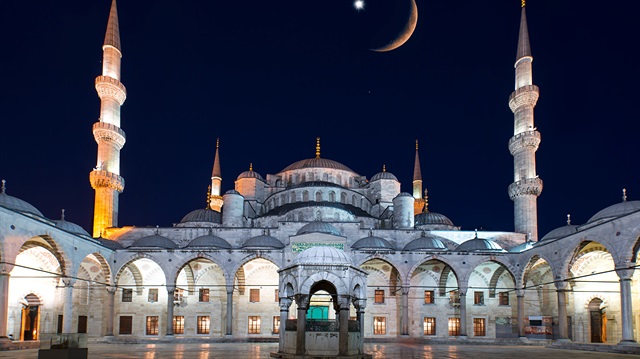
The cascading domes and six slender minarets of the Sultanahmet Mosque(better known as the “Blue Mosque“) dominate the skyline of Istanbul. In the 17th century, Sultan Ahmet I wished to build an Islamic place of worship that would be even better than the Hagia Sophia, and the mosque named for him is the result. The two great architectural achievements now stand next to each other in Istanbul’s main square, and it is up to visitors to decide which is more impressive.

History

The Blue Mosque was commissioned by Sultan Ahmet I when he was only 19 years old. It was built near the Hagia Sophia, over the site of the ancient hippodrome and Byzantine imperial palace (whose mosaics can be seen in the nearby Mosaic Museum). Construction work began in 1609 and took seven years.
The mosque was designed by architect Mehmet Aga, whose unfortunate predecessor was found wanting and executed. Sultan Ahmet was so anxious for his magnificent creation to be completed that he often assisted in the work. Sadly, he died just a year after the completion of his masterpiece, at the age of 27. He is buried outside the mosque with his wife and three sons.
The original mosque complex included a madrasa, a hospital, a han, a primary school, a market, an imaret and the tomb of the founder. Most of these buildings were torn down in the 19th century.

What to See

One of the most notable features of the Blue Mosque is visible from far away: its six minarets. This is very unique, as most mosques have four, two, or just one minaret. According to one account, the Sultan directed his architect to make gold (altin) minarets, which was misunderstood as six (alti) minarets.
Whatever the origins of the unique feature, the six minarets caused quite a scandal, as the Haram Mosque in Mecca (the holiest in the world) also had six minarets. In the end, the sultan solved the problem by sending his architect to Mecca to add a seventh minaret.
The other striking feature of the exterior is the beautifully-arranged cascade of domes that seem to spill down from the great central dome. The arcades running beneath each dome add further visual rhythm. None of the exterior is blue – the name “Blue Mosque” comes from the blue tiles inside.
The main west entrance is beautifully decorated and very much worth a look. However, to preserve the mosque’s sanctity, non-worshippers are required to use the north entrance, off the Hippodrome. Hanging from this gate are symbolic chains that encourage everyone, even the sultan who entered on horseback, to bow his or her head upon entering.
Inside, the high ceiling is lined with the 20,000 blue tiles that give the mosque its popular name. Fine examples of 16th-century Iznik design, the oldest tiles feature flowers, trees and abstract patterns. The overall effect is one of the most beautiful sights in Istanbul. The Iznik tiles can be seen in the galleries and and on the north wall above the main entrance. The remaining tiles, which have a less delicate design, were made in Kütahya.
The interior is lit with 260 windows, which were once filled with 17th-century stained glass. Sadly, this has been lost and replaced with inferior replicas.

Festivals and Events

On summer evenings at 9pm, there is a historical narrative and a light show at the Blue Mosque. The commentaries are given in Turkish, English, French and German on various evenings.

Quick Facts

Site Information
Names:Blue Mosque; Sultanahmet Camii; Sultanahmet Mosque
Location:Istanbul, Turkey
Faith:Islam
Category:Mosques
Architecture:Ottoman
Date:1609-16
Patron(s):Sultan Ahmet I
Architect:Mehmet Aga
Size:Interior: 53m x 51m
Dome diameter: 23.5m
Dome height: 43m
Features:Medieval Tiles
Status:active
Photo gallery:Blue Mosque Photo Gallery
Visitor Information
Address:Sultanahmet, Istanbul, Turkey
Coordinates:41.005277° N, 28.976827° E   (view on Google Maps)
Lodging:View hotels near this location
Phone:(0212) 518 1319
Public transport:Tram: Sultanahmet
Opening hours:Daily 9am-6pm except during prayer times (about 30 min. five times a day) and midday on Fridays
Cost:Free
Rules:Tourists must enter through the north gate and remove their shoes at the entrance (plastic bags for shoes are provided). Modest dress is required for both men and women; women must cover their heads. Wraps are provided when deemed necessary by mosque officials.
Note: This information was accurate when published and we do our best to keep it updated, but details such as opening hours can change without notice. To avoid disappointment, please check with the site directly before making a special trip.